Showing posts with label Diamond Trust. Show all posts

Monday, July 07, 2014

Diamond Trust: Fourth Rights

Diamond Trust Bank is back for a fourth rights issues in recent years from its 11,136 shareholders at a rate of (Kshs 165) $1.95 per share, with each of shareholder entitled to buy 1 share for every 10 held. This follows others done in 2006, 2007 2012  and now this one.

Contrasting the four issues 
Year - Nov-06 ; Nov-07 ;  Jul-12 : Jul-14
Target (Kshs M) – 735 ; 1,600 ; 1,809 : 3,631
New shares (M) - 15.5 ; 23.3 ; 24.4 : 22.0
Price (Kshs)  - 50 ; 70 ; 74 ; 165
Ratio  -  1:8 ; 1;6 ; 1;8 : 1:10
Budget (Kshs M) 41.6 ;  54.7 ; 57.6: 100.1
  • The IFC remains as a principal funder and shareholder for the bank.
  • Diversification has paid off with the bank having 30% of assets and 19% of profits from outside Kenya. While 77% of Diamond Trust's $61 million after-tax profit is from Kenya, the Tanzania and Uganda operations contributed about $7 million each of profit with Burundi trailing at ~$150,000 
  • They have extended traditional banking services in the mobile and card age by having M-Pesa at all their ATM machines. They also issues prepaid cards  for NationHela, NakumattGlobal and MiCard and handle remittances/money transfer for WesternUnion, MoneyGram and XpressMoney
  • Others institutions that may need to have rights issues or raise capital this year include ABC, Commercial Bank of Africa, Consolidated and Equatorial banks. 

Wednesday, November 27, 2013

Improving NationHela

Despite the ease of use, and convenience of Nation Hela as an online prepaid card and as a travel card, there are few challenges that need to be tweaked to improve the user experience for National Hela users.

Card Top Up 
The only reliable way of topping up the card is by physically going to a Diamond Trust Bank branch. Agents of the bank don’t handle NationHela top-up’s and surprisingly, Safaricom’s M-Pesa - which would be the ideal way for millions of Kenyans to load a card - does not work all the time. It’s a hit or miss experience, with many phone calls having to be made to Hela at Diamond Trust to trace the date/time/amount of the M-Pesa transfer – only for that to be reversed. 

Account Management
For now you can request for an abbreviated statement by SMS, as well as get an SMS each time you transact with the card in Kenya.  

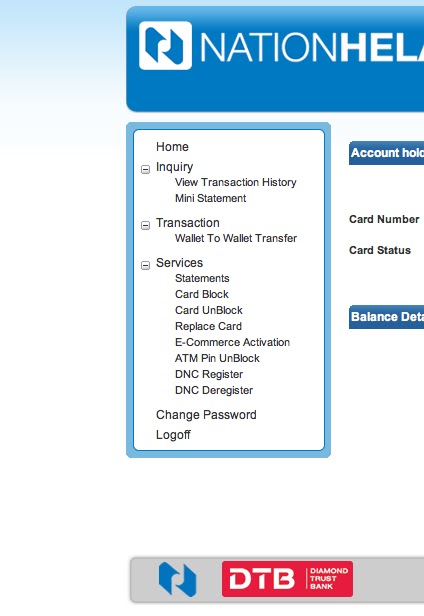
There's also the NationHela site, where a user should be able to view a history of transactions, and do other functions like block a stolen card. But access to the site remains a challenge - at first it looked like another bank site that only works on Internet Explorer browser and a Microsoft Windows PC combination, but no matter the device tablet, mac, or PC laptop, access to the site is a challenge - with password characters not visible, password changes not reflected, pop-up’s (that are auto-blocked on many browsers due to spam) etc. 

Easy of top-up and viewing transaction history are two essential user experience challenge points that need to be addressed, for the card to get wide acceptance.

Friday, August 17, 2012

Nation Hela to revolutionize remittances & debit cards in Kenya?

On August 15, 2012, Kenya’s Nation Media Group (NMG) launched NationHela in partnership with Diamond Trust Bank and Craft Silicon. NationHela had been first unveiled the previous week, when NMG announced 14% revenue growth to Kshs 5.8 billion and a 23% rise in profits of Kshs 1.37 billion and an interim dividend of Kshs 2.50 per share  for the first half of 2012.

Why NationHela? For NMG that has millions of online newspaper readers every month, a good fraction of who are in the diaspora, and who also send remittances to Kenya, the platform is a chance for them to send money without leaving their computer (or logging off the newspaper site)  – by entering debit or credit card numbers to send to a Kenyan phone number. 

At the launch, a Central Bank of Kenya a figure was cited of remittances of $590 million in the year  to June (up from $409 million the previous year) through formal money transfer channels.

Senders also get value as NationHela can be 30% cheaper overall (charging $12.5 to send $200 compared to $15 for other services), while for  the recipient it knocks out the necessity of taking a matatu (vehicle) to town or finding a Western Union agent to withdraw cash. 

 Diamond Trust who are the 7th largest bank, and the largest agents of Western Union in Kenya, handled the banking regulatory and approvals, and will also do the back office processing of money movement, agents, currency exchanges, float etc., while Craft Silicon provided the mobile interface (familiar to anyone who’s used their Elma) through which users will access Hela by USSD on a mobile phone to get notifications, send or receive money through mpesa to other card users, pay some utility bills, block a lost/stolen card, see a mini statement /balance among other features.

Some cited uses of the card include:
- Make online purchase as a visa debit card
- Move money to or from mpesa
- Withdraw cash at any ATM via visa
-  Use the debit card in a supermarket to make payments

Other future or potential uses include:
-    Pay dividends straight on to cards (maybe starting with Diamond Trust and NMG shareholder)  
-     Kenyans with paypal can move their online money on to the card and cash out payments
- Senders will also be able to too how card recipients use the money they have sent (perhaps answering along standing issue about misuse of remittances 
-  Take NationHela to Tanzania and Uganda where both the Nation and Diamond Trust are
-   Pay staff travel  allowances and imprest at companies (said to happen at NMG)
 
Outlook Some concerns have been expressed, that NationHela may not work out, or that it's going to distract NMG  from it's core media business. Also the web interface needs some tweaks to make the card easier to work.

While the awareness and usage of debit and credit cards in Kenya has been low, for NationaHela there  are plans for online education & marketing campaigns targeted at the diaspora, combined with road shows and town hall meetings around Kenya to register users, convert agents, and show how to use it on a day to day basis - and we’ll see where they are in a year. 

Wednesday, August 08, 2012

Diamond Trust: Third Rights

Diamond Trust Bank is back to shareholders for some fund raising after two rights issues in 2006 and 2007. 

Since venturing into  Uganda and Burundi in  2008, it has become a pan-African bank growing from assets Kshs 45 billion and Kshs 1.6 billion in profits to 2011 assets of  Kshs. 107 billion and profits of Kshs 4.3 billion. The additional  funding will be invested in Tanzanian Uganda and Burundi as well as alternative channel categories.

Like the previous issues, this one closing on Friday August 10, is likely to exceed full subscription. All the large investors - Aga Khan Group (AK fund for economic development fund  (owns 17%), Habib Bank (11%), Jubilee Insurance (10%), and the International Finance Corporation (IFC owns 10%) have committed to take up their rights.

The above commitments are for 51%, and with the minimum target is 60%, there’s a rump option in in case other shares are not taken up but it's expected that most of the 11, 242 shareholders will pay up (there was little trade in rights when it opened).

Contrasting Rights
Year - Nov-06 ; Nov-07 ;  Jul-12
Target (Kshs M) – 735 ; 1,600 ; 1,809
New shares (M) - 15.5 ; 23.3 ; 24.4
Price (Kshs)  - 50 ; 70 ; 74
Ratio  -  1:8 ; 1;6 ; 1;8
Budget (Kshs M) 41.6 ;  54.7 ; 57.6
 
Others
- IFC has also provided funding of about $65 million for the banks operations.
- All the arms of the company are profitable; Kenya profit after tax of Kshs 2.2 billion in 2011, Tanzania (own 55%) Kshs. 398 million, Uganda (own 54%) Kshs. 315 million and Burundi  (own 67%) Kshs. 31 million
 - Diamond Trust only owns 3 of their branches in Kenya (out of 38) , and none of the 22 in Uganda, 14 in Tanzania or 4 in Burundi.
- There's no indication of interest to venture into Rwanda or South Sudan as with many other Kenyan banks.

Friday, December 04, 2009

2009 Kenya Bank Rankings Part II

10. Diamond Trust (2008 rank 11) : assets of 44.9 billion ($600 million) and nine month profits of 1 billion ($14.2 million). Loans (28.6 b) grew faster than deposits (33.1b), but expenses also grew faster than income. Neck and next with NIC and I&M banks with 44 and 41 billion in assets in position 11 and 12 respectively.
9. Commercial Bank of Africa (7): assets of 52 billion and nine month profits of 1.39 billion. Deposits flat (40 b) but loans (28.2 b) are up 20% this year and with GOK paper up 77%, however income and expenses are lower than 2008.

8. National Bank of Kenya (9): assets of 55.2 billion and nine profits of 1.4 billion. The bank is in great demand with a planned further divestment by GoK which may attract significant interest next year. For 2009, NBK has had a remarkable 40% growth this year, with 27% loans (12 b) and 48% in deposits (41 b)

7. Citibank Kenya (8) assets of 55.6 billion ($742 million) and nine month profit of 2.3 billion ($31 million). while embattled in the US, Citibank had a slow down in growth of loans (22.7 b) and deposits (29.7 b) compared to ‘08 but will still record a healthy +20% growth for year 2009.

6. CFC Stanbic (4) assets of 83.5 billion and nine month profits of 981 million. Bank had no growth in loans (43 b) and assets, but sitting on a load of cash - almost 16b billion (~$214 million)

5. Equity Bank (6) assets of 92.4 billion and nine month profits of 4.2 billion. Equity is still one of Kenya’s fastest growing banks though the 100% growth margins have tapered off to more manageable 30%+ for loans (55 b)and deposits (63 b) as it expands regionally in Uganda and Sudan and continues to roll out unique banking products.

4. Cooperative Bank of Kenya(5) with assets of 98 billion and nine month profits of 2.9 billion. The bank continues its 20%+ annual growth a year after listing and has diversified into investment banking. However their re-jigged executive shareholding following n ESOP is a sore point to be debated further.

3. Standard Chartered 3 with assets of 122 billion ($1.6 billion) and nine month profits of 5.2 billion ($69 million). Despite my earlier negative outlook, stanchart was a late bloomer and has come on strong: significantly, unlike other big banks, stanchart grew faster this year compared to 2008 - with 18% growth in deposit (89 b) and loans (40 b) while profits are up by 40% as income is up 23% compared to just 5% for costs while spearheading technologial products & services to their customers. Also increased investment in government securities by 77% and holds ~ Kshs. 36 billion now.

2. KCB (2) assets of 163 billion ($2.17 billion) and nine month profits of almost 5 billion ($66 million). KCB group is larger than Barclays in assets (185 b to 168 b) but has a smaller asset base than last year. In 2009 deposits (133 b) and loans (93 b) are up over 20% but profit is up just 3% - income is up 11% but expenses are up 15%, as KCB continued its expansion, opening six branches in November and also expanding in Rwanda Uganda, South Sudan and soon to Burundi. The bank also continues to weather occasional storms against it sustainability with triton and now Kenya planters coffee union.

1. Barclays Kenya (1)assets of 168 billion ($2.25 billion) and nine month profits of 6.63 billion ($88 million) . Barclays shrunk by 2% compared to growth of 17% a year ago with lower deposits (123 b) and loans (96 b) compared to a year ago but with profits ahead of last years pace, perhaps boosted by GoK securities investments which are up 23% this year.

Friday, May 30, 2008

Diamond Trust 2008 AGM

Diamond Trust (DTB) held their AGM at KICC on Friday May 30. It was quite routine and the Chairman rapidly breezed through the vote items – annual accounts, re-election of directors, auditors’ yada, yada.

Extraordinary items were:

Expansion into East Africa: shareholders voted for the company to take up rights in DTB Uganda (probably cross 51% and making that a subsidiary) and to set-up in Burundi. Questions were asked on if more capital would be called upon from Kenyan shareholders and the difficulty of expanding into an unstable, war-torn, francophone country. The Chairman answered that the funds from the last rights issued (2007) were being utilized for the expansion and they have researched and visited the country which is now stable part of the East African community. He added that new CEO identified for Burundi is multi-lingual as are some Kenyan staff that may join the burning office.

The hot button issue of the day was the various amendments to the companies’ act that would enable the company to sell shares of dormant investors. The motions targeted shareholders who have ceased to be active; i.e. forwarding address, no dividends banked or bonuses taken up, mail returned etc. for over six (6) consecutive years. The company loses a lot of money in a bid to ‘serve’ these shareholders and was making moves to clean up their share register.

Steps followed would be to:

- Identify the shareholders dormant for six years
- Publish their names in the east African media, calling on these individual/their relatives to step forward
- For those who have not responded the company will then apply for permission to sell these shares at market rates
- Proceeds of sale will be held in trust for another three years
- After this (nine dormant years) such funds not claimed will revert back to the company’s shareholders funds.

The directors stressed that they were reluctantly making these moves in a bid to be on par with other companies (including yet to list Safaricom) and it would also keep them a step ahead of the government who have already made into law that dividends unclaimed seven years will revert to the Government (CMA investor compensation fund)

Several shareholders expressed their concerns and objections, saying this was a dangerous precedent, and citing (among other reasons);
- shareholders who were out of the county directors said they should just forward their correct address to the registrars
- shareholders who had died their dependants should contact the company
- shareholders whose shares had been lost to ‘rogue’ brokers that was a matter for the regulators
- shareholders who had not disclosed holdings to their families, and perhaps died
- company should only focus on unclaimed dividends, not selling shares
- shareholders with no bank accounts

They also came up with suggestions including DTB to
- provide a beneficiary form for investors to fill out beforehand (directors’ answered that it was a company’s act matter)
- DTB to buy more shares with unclaimed dividend for dormant shareholders (an investment decision that was every risky to the company)
- DTB not to sell the shares which may bring lawsuits in future, but instead ring-fencing the dormant shareholders and treating them differently (the laws of Kenya require all shareholder to be served equally (Mobitelea, anyone??)

DTB’s legal adviser, lawyer George Oraro explained that shareholders had ample time (nine years) to sort out any dormant share matters and that DTB would even exceptionally consider cases where investors with were not able to sort out their affairs in time. He added that in future the CDSC (not company registrars) would be the custodians of all share accounts

The motion was eventually passed

Goodies: Tote bag (with DTB cap, spiral notebook) lunch box (juice, water, apple, samosa, drumstick, chicken pie)

Hat tip: Coldtusker was in the house and asked some pertinent questions.

Friday, May 09, 2008

Regional diversification

Taking regional investments a step further - how are various local listed companies doing on the regional front? January 2008 showed that having a focus on Kenya alone could be an Achilles heel despite it being considered one of the strongest economies in the region. Various listed companies are making pushes in East and Central Africa – however many of these countries are all dependent on Kenyan access, hence its not really true diversification of political risk. In that sense, Olympia Capital, an NSE laggard may be ahead of its peers with its tangled Botswana and South African corporate moves.

here’s a recap:

- CMC says regional sales are on target in Uganda and Tanzania (from ½ year results this week)
- Diamond Trust has set its sights on Burundi (adding to Uganda and Tanzania) while many other banks have targeted Rwanda
- East Africa Cables attribute good performance to their subsidiaries in Uganda, Rwanda and Tanzania
- KCB has subsidiaries in Uganda, Tanzania and S. Sudan (though it wrongly had the flag of Sudan on its’ annual report cover. These countries contribute less than 10% to their income and Ug had a loss of 49 million (setup costs) while Tz barely broke even with a profit of 0.2m in 2007. KCB opened in Kampala in November 07 and will open 6 more Ug branches in 2008, 4 new ones in S. Sudan in 08, and another 20 new branches in Tz over the next two years according to their annual report
- Kenol who after acquiring Kobil could be the first 100 billion shilling turnover company, have subsidiaries in Uganda, Tanzania, Rwanda, Zambia and Ethiopia. 80% of their sales are from Kenya, while the other countries contribute about 20%.
- TPS East Africa acquired 8% of Serena Rwanda which includes Kigali Serena and Lake Kivu Serena. Of Serena's 2007 sales of Kshs. 3.7 billion (~60 million), Kenya accounted for 64% and Tanzania 36%.
- Total Oil Kenya has sister companies in Uganda, Tanzania Congo Rwanda so essentially remain a Kenyan company with 97% of their sales being local. They however complain in their 2007 report that other countries who should be buying from Kenya are (because of our tax regulations) buying offshore and shipping through Kenya instead.
- Sameer Africa are looking for transporters to Somalia, DRC, Ethiopia, Rwanda, Sudan, Burundi, Mozambique, Zambia, Malawi Uganda and Tanzania for their products.

Saturday, May 03, 2008

Regional banks and dueling websites

Diamond Trust Bank will this month ask their to approve
- participation of the bank in a rights issue of their Ugandan subsidiary
- Approve expansion to Burundi (odd or smart considering that other banks have focused on Rwanda)

dueling web sites

DTB new corp name have a new website but they should probably map /discontinue their old site or it may give the impression that its another company that doesn’t bother to update its website.

KCB who are also going to increase their capital to support regional expansion, and cross listing on the stock exchanges in Tanzania and Uganda, have consolidated their company to a group website, abandoning their kcb.co.ke

Also caught up in the confusion of domains between (.co.ke) and (.com) is the Safaricom IPO. The former is the official site, which applicants could use to apply online for shares. The government should have cracked down on transaction adviser - Dyer & Blair who opened the latter site and may have created some confusion. Though more active and up to date (even has a blog of sorts), the Dyer site attracted people who thought it was the official site and some confused investors have been logging in their to track their applications without realizing that it is not the official site

Wednesday, February 20, 2008

From Banks to Chips

IFC funds D-Trust diversification: Diamond Trust Bank will get a $45 million (Kshs. 3.2 billion) loan from the Investment Finance Corporation this year: a subordinated loan of $15 million; and $30 million for housing finance, on lending to SMEs, consumer financing, education/student loans, health-care, and agribusiness financing. (Note: I own shares in Diamond Trust)

Super Barclays: Barclays Kenya is the first bank to announce ‘its profits for 2007. They are up about 7% from the subdued profit of Kshs. 7 billion ($100 million), but the profits of Barclays makes in African Countries mean that the units are too expensive for Absa

From the Blogs
- Local TV leader KTN follows NTV by expanding into Uganda
- Just how free is free secondary education?
- Inflation update: One common item I missed in inflation tracker is Chips (French fries). They are a popular Nairobi meal that’s cheap, and filling, often goes well with a ¼ chicken from Kenchic. But the price of chips has shot up in the post election period – from 20- 30 shillings ($0.4) for a pack/plate, to abut Kshs. 50 – 60 ($0.85) at the same Kenchic joints. The price of cooking oil has also gone up by about 30 – 40% in supermarkets – which may be contribute, as would the availability of potatoes which were produced in clash-hit areas.

Saturday, December 22, 2007

Bank Review '07: Part III

Middle of the pack

20. (20) Fina Bank: Estimated assets of 7.6 billion ($108 million) and profits of 90 million shillings ($1.3 million), with growth of about 20% from a year ago. Opened upcountry branches in Kenya (Nakuru, Mombasa, and Eldoret) and will start branches in Uganda next year, bridging the Fina to their existing Rwanda operations.

19. (22) Family Bank: Estimated assets of 9 billion and profits of 220 million in 2007. Known as Equity Blue, it has enjoyed similarly rapid growth (though slightly less this year) since converting from a building society to a bank. It has followed Equity's footsteps, applying for the same exemptions granted to Equity - such early as admission to the clearing house and permission to issue chequebooks. It has also opened branches at a fast rate and its paperless banking model and women-entrepreneur loan models are a hit with rural Kenyans. But, in the year in which they converted to a Bank, they also lost their long serving CEO over board dispute and got sued by a Central Bank official who their Chairman had accused of being corrupt.

18. (18) EABS: Estimated assets of 9 billion and profits of 15 million. Teething pains continue at the former building society which converted to a bank three years ago, and had growth of about 5% in 2007.

17. (17) Housing Finance : Estimated assets of 10.5 billion and profit of 120 million, with loans 15% up from a year ago but assets only 2%. The bank tried to merge with Development Bank of Kenya, and later raise cash in a rights issue, but both plans were scuttled by regulators; later the board signed to sell a 25% stake to Equity Bank. HFCK and S&L (owned by KCB) are still major players in the mortgages sector which is becoming a crowded field with newer entrants Stanbic and Standard Chartered. HF also lost a class action lawsuit filed by customers over illegal bank charges.

16. (19) Bank of India: Estimated assets of 11 billion and profit of 500 million for quiet bank that grew at about 25%. Does a lot of India related business and Kenya government securities.

15. (16) Imperial Bank: Estimated assets of 11.5 billion and profits of 600 million. In 2007, the bank grew about 40% as it launched shariah banking, asset finance, children’s accounts and opened new branches at the coast.

14. (14) Bank of Baroda: Estimated assets of 14.9 billion and profit of 600 million for quiet bank that grew at about 25% and does a lot of Kenya government securities investing. It has been in Kenya for 52 years

13. (15) Prime Bank : Estimated assets of 15 billion and profits of 350 million. The fast growing bank will consolidate with affiliate Prime capital company by year end leading to a much larger bank in 2008.

12. (11) Investment & Mortgages: Estimated assets of 30 billion and profits of 1.3 billion. Fast growing bank also diversified into shariah banking, custodial services and also acquired two new euro bank shareholders.

11. (12) Diamond Trust : Estimated assets of 31 billion and profits of 950 million. In 2007 the bank grew about 45% as it opened several new branches, had a second rights issue in less than a year and also acquired a majority stake in Diamond Trust Tanzania.

10. (8) NIC: Estimated assets of 34 billion and profit of 1.1 billion. The bank grew at about 30% in 2007. It had a rights issue, rewarded shareholders with a bonus, went into custodial and investment banking (acquiring a stockbrokerage firm). But the market leader in asset finance also faced increased competition from other banks in this field and was dropped from NSE share index in favour of ICDCI.

9. (5) Citibank Kenya: Estimated assets of 38 billion and profit of 1.9 billion shillings. Otherwise a flat year for the bank whose parent faced her own troubles in the US banking meltdown. Growth was about 5% as the bank got into the local IPO advisory races.

8. (6) Commercial Bank of Africa: Estimated assets of 40 billion and profit of 1.4 billion. Growth of 9% from a year ago got into unit trusts, home loans, insurance, and funding of women projects. Similar to CFC and would be prime candidate for a merger.

7. (7) National Bank of Kenya: Estimated assets of 45 billion ($645 million) and profit of 1.4 billion shillings ($20 million) for 2007. NBK finally had its most of its non- performing portfolio debt albatross sorted out with a government bailout in the form of bonds maturing over the next 10 years. Now that its cleaned up, it could once again be a target of Stanbic again who two years ago offered to buy out NSSF’s 48% after their CFC merger is done in 2008 (Equity Bank is a also long shot). During the year, NBK partnered with Standard investment bank offer stockbroking services through NBK branches and also tried to have businessman Ketan Somaia jailed over an unpaid debt to the bank

Jobs

- Chase Bank; Head of ICT, senior manager operations, head of trade finance. apply by snail mail to the Head of HR 28987-00200 by 29/2
- Cabin crew at Emirates airlines
- Fina Bank Uganda: The bank is starting operation in Uganda in January 2008, and those interested in working there should send detailed CVs to hr@finabank.com.
- tough job - Head of marketing & corporate communications at Kenya Airways apply online by 15/1

Wednesday, November 07, 2007

Diamond Trust; Rights Reloaded

Pressure is on for banks to raise capital and Diamond Trust are back to ask their shareholders to chip in. In November 2006 they raised 735 million, and this time they are set to raise 1.6 billion ($24 million)

What has changed
Then ; Now
Nov ’06 ; Nov ‘07
New shares 15.5 million ; 23.3 million
Price 50/= ; 70/= (a 20% discount each time)
Ratio 1:8 ; 1:6 (1 new share for 6 owned)
Result: oversubscribed; ? (Likely to be the same)

cost of the offer
Budget:2006 offer - 41.6 million ; 2007 offer - 54.7 million

What costs more: :
Advertising - up 250% (2.5m)
CMA approval – up 104% (4m)
Placing commission – up 100% (24.5m)
Printing & postage - up 29% (9m)
Registrar & data - up 29% (3m)
Legal fees – up 16% (4m)

Costs less
NSE listing fees – down 436% (0.09m)
Reporting accountant fees – down 200% (2m)
Sponsoring stockbroker fee – down 50% (1.74m)

Unchanged
NSE listing fees (0.5m), PR activities (0.5m)

calendar
record date 16/10, rights start trading 2/11, last day trade rights 12/11, last date to pay for rights 27/11, new share trade 11/12, new share certificates 18/12.

Tuesday, October 09, 2007

Diamond Trust rights issue

1 ½ years ago, Diamond Trust Bank raised 735 million from shareholders, and now they are back this time targeting another 1.6 billion shillings ($24 million). NIC bank also has a rights issue on-going while that of Housing Finance has stalled temporarily.

The rapid growth of assets, loans and deposits has created a gap in capital that banks will need to fill up to maintain capital adequacy and Basel II requirements. Other banks likely to require to raise capital could include Kenya Commercial (after a previous right issue 2004), Cooperative, National Bank of Kenya, Commercial Bank of Africa, Standard Chartered, Stanbic, Investment & Mortgages, Barclays, Equity, and even the new CFC/Stanbic Bank.

Monday, September 03, 2007

Kutwa Monday

The Capital Markets Authority (CMA) seeks to extend the statutory management of Francis Thuo stockbrokers stockbrokers (by the Nairobi Stock Exchange) for another 6 months (this is due to expire on September 6)

Are we ready for Basel II
Diamond cash again?: 1 ½ years ago the bank raised 735 million shillings, and now they're back for more cash as are NIC also with a rights issue (and bonus share). These fast growing mid-size banks want to comply with Basel II by 2010 which requires that they have adequate capital to cover not just credit risks, but also market and operational risks

Mumias glazing: Mumias dressed up some bad news glazed over reduced sales (-10%), profit (-9%), and cash with the promise of a dividend and a 2 bonus shares for each held – which apparently worked as the share closed 8% up on the previous week. . Still even the Business Daily was moved to decry insider trading in Mumias and EABL shares this past week

Opportunities

Road audits: from the Kenya Roads Board for engineering firms to team with financial audit firms to audit road construction work on behalf of the government by performing technical, performance and financial audits. D/l is 24/9

Strathmore finance seminar: on Friday September 7 at the Hilton on Kenya as an emerging capital market

Jobs

Celtel: revenue assurance & fraud manager, treasury & tax manager. D/l is 7/9

Director of information & public communications of the government of Kenya. details here and d/l is 7/9

Marketing managers (3) [branding, core network, wireless] at Huawei: apply to Kenya@Huawei.com by 14/9

Editorial staff at the Nation media group: they are looking for website editors, owners of popular blogs in east Africa, sub editor with niche publications - in their 20''s and 30's. apply for positions by picking any story in the nation or east African, rewrite it and send it back to editstaff@nation.co.ke by 10/9

Popote wireless: head of sales, IT account manager, sales engineers. Apply to hr@popotewireless.co.ke 14/9

Safaricom: principal credit controller, retail center agent, sales analyst, senior marketing & planning analyst. D/l is 7/9

Governance advisor - Kenya for the World Bank - d/l is 13/9

Tuesday, June 26, 2007

Convenient banking

making trades offs as convenient banking is not the same thing as cheap banking

Equity has been the fastest growing bank in the country over the last few years. It has won customers, now 1+ million, and has sent bigger banks banks back to the drawing board to woo & retain their customers.

However, while banking with them may not be cheap for a business, it is convenient, and offers finance and flexibility to an upcoming business. People coming from abroad complain about the cost of making mobile calls here – saying they are expensive. But compared to what? A taxi driver will make a 30 shilling mobile phone call to secure a 2,000 shilling job as his phone is his office.

Same with Equity their low entry minimums suit individuals and start ups. And while some of their charges are rather hefty (3% for ENC and 10% of amount for a temporary overdrafts), as a businesswoman told me today, their quick decision making and the fact that they are the only bank that can offer these facilities to her make them the optimal bank for now. Getting cheques cleared, guarantees, and payments to suppliers matter more to her now, than the cost of these services, and help her build a credit record for the future. Once she is more established,. she will look question the transaction costs and have other banks now wooing her business.

Other banking briefs

According to Africa confidential, Kenya is favored to be the new host country for the African development bank, with Botswana second in the ranking. However Ivory Coast is back in the running following the signing of a peace accord. More on homeless banks.

The CBR Bank rate was lowered from 10 to 8.5%

The Government has commissioned a study to look into the low uptake of youth enterprise fund and agriculture development funds. They are blaming banks for asking borrowers for collateral and 3 month bank statements – terms which were not spelt out in the funds. from an offline story from the East Africa:

CFC Stanbic bank pre –merger comparisons

Diamond Trust acquired a majority shareholding in Diamond Trust in the just concluded rights issue.

Equity Bank
- Looking to enter the money transfer business
- To buy Housing Finance bank - what do the bloggers say?

Family bank got admitted to the CBK bank clearing house earlier in June, just a few weeks after being licensed. Family took advantage and pressed for an exemption (on a two year waiting period), similar to that granted to Equity Bank when it also became a bank. from an offline story from the standard

National Bank is seeking to commit Ketan Somaia to civil jail over a 17 million debt

Pyramids schemes continue to
thrive despite numerous warnings. However, some schemes feeling a cash pinch are passing the blame to the central bank who are limiting the interest they can pay depositors to 10% p.a. - before they were paying over 10% per month.

LinkWithin

Related Posts with Thumbnails