Showing posts with label Kenya Airways. Show all posts

Thursday, November 12, 2015

Kenya Airways: Still in The Red

This morning Kenya Airways (KQ) released their half-year results. Some highlights from the investor briefing.  

• Half year Kenya Airways revenue was Kshs 56.7 billion same as last year. 90% is from passenger traffic, and  60% of their business is in Africa.
• Kenya's largest increase in tourists was in 2011, and the numbers dropped in 2012 & 13 with the largest decrease was in 2014, just as KQ added great capacity. JKIA passenger numbers have been flat for the last three years and for the last three months, they have had to adjust their schedule from 24 to 18 hours as the runway is being repaired.
• Half of airline industry profit is in North America, where strong capacity, consolidation, combined with ancillary revenue and lower fuel costs has had a major impact.  The Middle East has low yield compared to investment, and Africa has 3% of global demand. 
• Shareholder equity has gone from Kshs -6 billion last September, to Kshs -33 billion this year and KQ is talking to the CMA on how to reverse this.   
• KQ has a turnaround plan, developed with Mckinsey, with 24 initiatives worth a potential $200M, that starts this month.
• Despite fuel cost coming down from Kshs 21 billion to Kshs, 13 billion, the half year loss went from Kshs 10.5 billion to 11.9 billion 


Some other numbers
• Revenue per available seat decreased from 6.2 to 6.14
• Cabin factor was up from 64% to 68%
• Carried 2.14 million passengersm up from 2.10 million
• Cargo tons were 35,405 down from 37,255
• On time performance was 75% (down from 77%)
• Finance cost was 3.4 billion, up from 1.5 billion

The new chairman of the Kenya Airways board, Dennis Awori, thanked the government, financiers, and suppliers for their support for the airline. CEO Mbuvi Ngunze said that the senate enquiry is ongoing and on Monday, senators will, for the first time, visit the airline.

Sunday, November 08, 2015

FastJet Finally Get Kenya License

The three year journey to get low-cost airline FastJet into Nairobi now seems to be nearer to it's goal following the licensing of FastJet Kenya to operate domestic air services between Nairobi and Mombasa, Kisumu, Eldoret, and Wajir. 

However they were not granted other rights they had applied for to fly from Nairobi to  international destinations including Lusaka Harare Lilongwe and Entebbe that they serve from their current bas in Dar es Salaam, Tanzania. 

Still it's a start. In the three years since they were established JamboJet (one by Kenya Airways) has established itself as a reliable true low cost carrier in the country, while one of the main local airlines Jetlink has since gone out of business, leaving Fly540/Fly-SAX as the only other domestic airline with regular services to the main airports around the county. JamboJet also have designs on flying to neighboring countries, but an approval discussion was deferred in their case.  


Wednesday, July 16, 2014

Lady Lori & FastJet?

The latest round of airline license applications has a curious addition with Lady Lori previously known as a successful helicopter charter company applying for a variation of their current license.

Lady Lori are seeking to introduce domestic flights between Nairobi and Mombasa as well as to obtain rights for international routes from Nairobi to Dar es Salaam, Juba, Kigali, Entebbe, Maputo and Lusaka.

Across the border is successful FastJet who have not been shy about their ambitions for Kenya. But their license to operate which they intended to obtain via an investment in Kenya's Fly540 airline has been stuck somewhere in the government red tape while their Tanzania business has thrived and they are now the leading airline there. Recently, FastJet came to a settlement with Fly540 ending their acrimonious relationship. 

Could Fastjet now be starting afresh with an established and licensed operator? Lady Lori is applying for the above routes with the intention to fly Airbus A320 aircraft - which happen to be the only aircraft flown by FastJet.

FastJet, as a low cost operator has made the A320 the only airline in it's fleet and one that made a few people wondered how Fly540 with a mix of ATRs and Bombardiers would integrate.  Lady Lori offers a fresh start in this regard.

Tuesday, April 15, 2014

Understanding Low Cost Flights

Though FastJet and JamboJet applied at about the same time for aviation licenses to fly in Kenya, FastJet started in Tanzania in November 2012, and a year and a half later,  JamboJet, a Kenya Airways subsidiary has launched flights in Kenya. 

As low cost carriers, there are some differences which passengers here, especially current Kenya Airways customers, may not be able to understand.
  • Cost of tickets:  Going by the FastJet model, which JamboJet also has, there is the  unique pricing of tickets. While they advertise low prices of tickets e.g.Kshs 2,850 ($35) to Mombasa, Eldoret and Kisumu, not all seats on the flight cost that. The price applies to just a few and as soon as they are bought (preferably several days or weeks in advance of a flight), then the next batch of seats become available, at a higher rate. This goes on until fares bought on the day of the flight might be comparable or even more than the cost of a full fare airline. 
  • Extras: Next is that the airline makes money on many extra items - things that you take for granted on Kenya Airways, are items you pay for on JamboJet; these include luggage (only 10kg  hand luggage is free), meals (Kshs 500 for a sandwich, and Kshs 200 for a soda) and even seat selection (costs Kshs 710 to pick a specific seat that’s tinier than a Probox as per @themacharia).
  • Children: On FastJet international routes, children aged less than 12 years are not allowed to travel unaccompanied. But on JamboJet domestic, this is allowed at a fee and the child must be met by a parent/Guardian within 20 minutes after arrival or additional fees will be charged.
  • Luggage: With JamboJet, a passenger is allowed to purchase a maximum of 64 kg of checked in baggage. The only free baggage is the 10 kg hand luggage. Also, it is cheaper to pre-book and pay in advance for baggage than pay at the airport.  On FastJet, a passenger can pay for excess weight at a rate of $5 per kg up to a maximum of 32 kg.
  • Delays: If a FastJet flight is delayed by 1 - 2 hours, the airline will provide regular communication on flight status, and if the delay is 3 - 4 hours, refreshment vouchers of up to  Tsh 8,000 ($5) may be provided. If over 5 hours delay, FastJet will communicate a flight cancellation and refunds will be issued from the head office or  there will be a free transfer to (their) next available flight. So if a flight is canceled for operational, weather, or other reasons, the T&C states that FastJet will not provide flights with alternative airlines or hotel accommodation in the event of overnight delays or cancellations.
  • Changes All fares are non-refundable. On JamboJet, itinerary changes must be made 1 hour prior to departure -  and if at the time of change, the original fare is not available, the passenger will pay a higher fare 
Also, in other markets, low cost carrier operate from smaller airports which have lower landing fees or taxes. In Kenya, an equivalent would be flying from Wilson airport or Orly Air Park as opposed to JKIA.

For now, JamboJet operates on relatively short flights to Kisumu, Edloret and Mombasa so you won't notice that there’s no free meal service. JamboJet also has Kenya govt.  permission to fly to Wajir, Malindi, Lamu, Juba, Hargeisa, Kisangani, Pemba, Moroni, Entebbe, Dar es Salaam, Mwanza, Bujumbura, Kigali, Dzaoudzi, Goma, Mwanza, Antananarivo, Zanzibar, Kilimanjaro and Addis Ababa.  Over in Tanzania Fastjet flies to Mbeya, Mwanza and Kilimanjaro, and also flies to South Africa and Zambia.

Sunday, April 06, 2014

Boeing 787 Dreamliner Arrives at Kenya Airways

On April 5, Kenya Airways (KQ), received, The Great Rift Valley - their first Boeing 787-8 Dreamliner aircraft in Nairobi.  
KQ's new B788 arrives

KQ Managing Director, Titus Naikuni, said their aircraft were 3-4 years behind schedule and thanked the airline staff, passengers and sales people for putting up with older aircraft in the interim. He added that plans are still on course for KQ to get more Dreamliner planes every month between June till October 2014. 

KQ Chairman, Evanson Mwaniki who was on-board the 16-hour non-stop flight from Paine Field, Washington to Nairobi, said they been assured at the highest levels of Boeing that the 787 program's teething problems had all been sorted. He said each Dreamliner with engines cost the airline Kshs. 11 billion (~$130 million seems low), while the new Boeing 777-300's arriving were Kshs 18 billion ($211 million)  and yet they are competing for routes with Gulf nation carriers with seemingly unlimited pockets who could order 100 aircraft when KQ orders 9.  He made three requests of the Government; to expedite bilateral air service agreements, sort out double taxation that penalize the airline and also expedite VAT refunds.

Tracking the Great Rift Valley
Transport Cabinet Secretary,Engineer Kamau said Gok and KQ had worked on new terminals (greenfield started, Terminal 4 ready in July), and new aircraft (777, 787) and invited the President to use Kenya Airways for trips and for KQ to use the President who travels a lot and get themselves on agenda for such trips. 


Also at the launch was the President of Somalia, Hassan Sheikh Mohamoud, who said terrorism was a global challenge - and that, while Shabaab was associated with Somalia where it gained a foothold in the then-lawless state, it is now losing ground in terms of financing, recruitment and training. He thanked Kenyans for their tolerance and accommodation of business  people and said Somalia was on track for a first election in 45 years in 2016 in which women would also vote. 

President Kenyatta said KQ had more of a global reach than Kenya embassies so were in essence first ambassadors for the country and that in his personal experience it had the best pilots and crew in the world. Late he noted that pilot costs are heavy, and that KQ’s labour is less productive than Ethiopian Airlines and that it was necessary for the airline to simplify operations and get better staff productivity.  He also said that Angola had agreed to open an embassy in Nairobi  - a relief to many as Kenyans applying for visas have to do so via Dar es Salaam, Tanzania. 


Engine cool-down after the extra long flight
The new aircraft is part of Project Mawingu, the airline's massive fleet and route expansion program. It will start on the Paris route in June and in between will be used for familiarization of staff, training, and be showcased to key KQ markets.  At the launch, a General Electric representative thanked the airline for having over 100 of their engines in the fleet, while a Boeing VP said KQ had designed and selected one of the best Dreamliner interiors on offer.


Friday, January 17, 2014

KQ’s 787 Countdown

About four years behind schedule, and eight years after Kenya Airways placed an order, the airline is getting ready for delivery of its first Boeing 787 Dreamliner. KQ now has a teaser Dreamliner video on YouTube, and this image of their first aircraft on Facebook.  
KQ 787 at Everett, Washington


From the All Things 787 blog, at least three KQ Dreamliners are in the production stages with  ZA655, a Boeing 787-800, with GE GEnx-1B engines, undergoing final assembly at Everett, Washington

Two Dreamliners were expected in 2010 and four in 2011, but after production delays at Boeing, KQ is now expected to take delivery of a first 787 around April 2014.

Boeing did bring a 787 to Nairobi in 2011 during the Dreamliner World Tour, and Ethiopian Airlines who are the only African airline that currently fly the aircraft, seem to bring one to Nairobi each week.

EDIT: At #Mindspeak chat session on January 25, KQ CEO Titus Naikuni explained he delivery schedule of Boeing 787's to Kenya Airways as:

1. April (1st week) 2014
2. June
3. July
4. August
5. September
6. October

So KQ get's new 6 787's in 2014, and another 3 in 2015, as they retire their Boeing 767 fleet and return all of them, but one, to their owners. They will also add a second Boeing 777-300 in June and another in August, and plan to refurbish their current fleet of 4 Boeing 777-200's.

Friday, November 15, 2013

Guide to Abu Dhabi

Getting There: There are direct flights from Nairobi to Abu Dhabi on both Kenya Airways and Etihad that cost $600-700. There's also Qatar Air with a stop-over in Doha and   Emirates Air to Dubai, but which ends with a bus ride to Abu Dhabi City (it's about a 150KM drive, and rather too short for a jet flight).
 
Sunset at the Yas Marina F1 track
Prior to departure, your airline would usually have arranged for a visa in Nairobi which is emailed ahead of the trip. The costs of the visa may vary depending on who's doing your booking, and it can sometimes be free if you pay for a full holiday package. Mine cost $82 and  included (a surprise) medical insurance that covered the trip.  
 
On arrival. Clearance from the airport would have been quite fast, but it took about 1.5 hours as most people had to have an eye scan (picture) taken first and the queue was very long. Many tourists were arriving for the Abu Dhabi Grand Prix) and there were long queues for the scan, and for a rubber stamp after from a very tired official who was taking many cigarette breaks.
 
Getting Around: One company operates all the taxis you see around Abu Dhabi. Their website advises passengers of their rights such to see driver's ID, have the electronic trip meter running, have the air conditioner on in the car, and they can refuse to  share the taxis with other passengers - sometimes there's a shortage of cars at busy times, and the in-car computer advises taxi drivers to go to certain points where there are many people waiting for rides. 

The computer also cautions taxi drivers if they exceed the speed limit. The city is a marvel of wide highways, with fast moving traffic, and a level of orderliness that will be shocking to Kenyans. Traffic lights are strictly observed and it's rare to find a traffic jam in the city.

The taxi journey from the airport to the hotel was about 50 Dirhams (AED) while a trip to a mall or office will be about 20 Dirhams. If staying longer than a week, one should learn to use the city bus system. With the heat and large spread of the city, walking long distances is not feasible.
 
Roaming Rates
Staying in Touch: Roaming rates are atrocious so get a local SIM card such as from Qtel or Du. This can be obtained at the airport in the case of Du and a line costa AED 100 (about Kshs 2,500) for a combination of call minutes and data that can also be topped up. Also, Wi-Fi is standard at many hotels as there are a lot of intentional business visitors.
  
Where to Stay: There are many international hotel brands in Abu Dhabi such as Crowne Plaza, Holiday Inn, Rotanna, Ritz Carlton, Westin, Intercontinental, Hyatt, Sofitel, Fairmont, and Radisson. Some of these are located at Yas Island which overlooks the formula one track that has a race in November each year. 

The National  newspaper was available in the hotel lobby for all guests free every day, and most hotels have discrete bars on the top floors serve alcohol to guests. Standard rooms with bed & breakfast go for about $100-250, and this comes with the standard international breakfast buffet, along with a touch of local foods like porridge, humus, sticky rice, seaweed soup etc.

Gold Souk
Shopping & Sight-Seeing: Abu Dhabi is considered one of the more expensive cities for visitors and it will cost an equivalent of about $50-100 per day for 2 to 3 taxi rides and meals around the city. (Excluding hotel costs). 


Credit cards are widely accepted in most places, except in taxis which only take cash in local currency. The UAE Dirham can be exchanged into about a dozen other currencies (Singapore, India, Euro) and the  dollars (fixed at about $1 = 3.6 AED) at forex bureaus in malls and the airport. 

There are a few large shopping malls (Marina mall, Abu Dhabi mall) and Souks (markets) like the gold souk that is located in the Madinat Zayed shopping centre. For transit flyers (using Abu Dhabi airport), the duty free section there is rather tiny, and pricey,  compared to the selection at Dubai airport. But if you fly in with the Eihad, the national carrier, showing your boarding pass around town may entitle you to discounts at some hotels, restaurants, car rental, and recreation sites.

Practice your pit stops at Ferrari World
Sights to see include the  Sheikh Zayed Grand Mosque, and lot's of unique architectural towers. Others popular with tourists include the Corniche which is a 6 KM long  park where you can cycle, jog, even swim in the heat, and another is Yas Water World. But one of the most unique sites here is Ferrari World Abu Dhabi on Yas Island where adults and kids can can spend hours on a variety of motor stuff - roller coasters, virtual reality tours of the Ferrari factory, view the history of Ferrari racing, race karts, eat, shop for merchandise, and still not cover the entire complex. 
 
With more time, you can do other stuff like take a desert drive, boat ride (from Yas Marina), or go to other cities like Al Ain and Dubai which is about 1.5 hours max away on a 'real' super highway. 

Odd Points: Abu Dhabi is a Muslim country, but one that's quite moderate in terms of what's forbidden. Still there are signs cautioning visitors to dress modestly, and not to engage in public displays of affection, or consume alcohol in public.

Also the taxi drivers who are an international mix from many countries like India, Pakistan, Philippines, Algeria etc. are the people you are most likely to have a long conversation with during a brief stay. You encounter foreigners at almost all service points - with hotels, shops, malls, restaurants all staffed by a similar mix of foreigners, that you will wonder where the local Abu Dhabi residents are! 

Tuesday, November 05, 2013

Guide to Khartoum

A guest post by @Wiselar   

Getting There: If flying from Nairobi, you have an option of either Kenya Airways (KQ) or Ethiopian Airlines. Kenya Airways operates both a late night (23:55) and a late morning (11:00) flight from Nairobi that costs about $600. For the Ethiopian flight, you will have to connect via Addis Ababa but it's cheaper at about $450.

I went on the night flight from Nairobi's JKIA. KQ operates an Embraer 175 on this route (though this changes a lot) and the flight time between Nairobi and Khartoum was about 2.5 hours. 

On Arrival: On arrival in Khartoum (same time zone as Nairobi) at about 3 a.m., there was little activity at the airport other than our arriving flight.

Immigration forms are readily available, and must be filled in duplicate. You must also watch out for the spacing on the form as they are arranged to cater for Arabic which goes from right to left. After filling the forms, processing at the immigration counters is pretty quick. This is followed by a security screening of carry-on luggage before being going to the baggage pickup area where with several baggage carousels around,  luggage was ready for pickup on time. Airport officials require you to have your baggage tag and they counter-check against the one on your checked-in baggage,  so keep it close.
Khartoum Airport road

Sudan requires all visitors of other nationalities to register as aliens on entry to the country and this costs $40. This should ideally be done before you leave the airport but you can also do it the next day if you don't make it the first time. Most importantly, you will not be cleared to leave Sudan if you don't register as an alien. This can cause inconvenience you, if you didn't know about it or and didn't spare enough time especially on the day of departure, when it can be even more difficult or confusing as most officials only speak Arabic.

Getting Around: I had arranged a pickup with the hotel but a taxi from the airport to my hotel (about 14 kilometers away) would have cost about $10. There was no traffic at this time of the day so these charges may vary. I noticed there were more private vehicles than public means around Khartoum. Still taxis are readily available and they are not too costly, but it's always better to ask the hotel or a host to arrange the taxi for you and pre-negotiate the rates.

In Sudan, they drive on the right side of the world as does most of the Arab world. Also it can get very hot, and people drive around with the air-conditioner on.

Rickshaws are also a very popular mode of transport in Sudan, and some owner do some extra 'pimping' work on them, such as shiny rims, to make them stand out. 

Staying in Touch:  If you're a Safaricom customer like I am, roaming in Khartoum is via Airtel Sudan, Khartoum. Making calls and texting worked fine as expected but it was still expensive, and data charges while roaming are exorbitant so ensure you have your data turned off to avoid accidental connection. If you have to use your phone a lot, consider buying a local SIM. There are several local providers - Sudani, Airtel, MTN - but the biggest is Sudani. I didn't get to purchase a local SIM but I'm sure this should be easy. 

Out & About: Sudanese people are generally friendly. Being a Muslim country, the weekend is on Friday and Saturday with the first day of the work week being on Sunday. The locals are pretty easy going and not too concerned about security. This is unlike Nairobi where you always have to be on the look out. Since it is very hot outside, there are very few people walking the streets.

There's also little or no police presence around town. This is unlike other African cities such as Abuja where there's quite a heavy military and police presence

Arabic is the most widely spoken language in Khartoum. Hotel staff and officials from the meeting I went to were able to do basic communication in English. A lot of signage is in both Arabic and English so it is easy to get around. All the newspapers and other publications I came across were in Arabic.

Being an Arabic country, food is eaten communally, from a central serving with smaller side dishes to accompany. Bread and meats are common. Pork is not allowed due to religion, and mutton (goat and sheep) is the most common type of meat.

As with many other African countries, politics takes center stage in conversations and to sum it up, the Sudanese people don't defend Al Bashir as much as Zimbabweans do Mugabe.

I had to change to the local currency of Sudanese Pounds (SDG) as most places outside hotels will not accept US Dollars. With a daily budget of $20 for a meals and $40 for taxis per trip, you can make it around the city.
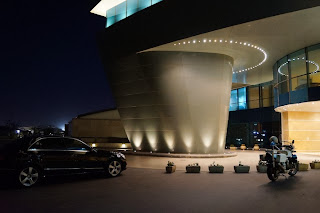
Outside Khartoum's Corinthia Hotel 
Where to Stay:  I stayed at one of the better hotels in Khartoum - Corinthia Hotel. A similar classed one would Al Salaam Rotana. A standard room at the Corinthia went for $210 for bed and breakfast before taxes.

Shopping & Sight-Seeing: There aren't too many shopping spots around Khartoum. I also didn't get time to go into their famous Afra Mall. You can however get places to buy curios (usually sold by South Sudanese nationals) but with very little variety.

Places for visitors to see include the meeting point of the Blue and White Nile rivers, which is a the sight. I was lucky to stay at a hotel that overlooked that view. My hosts mentioned there are tourist boat rides on the expansive Nile, and I would have loved to go on one, if I had more time.

Odd Points: Due to sanctions, US products have little presence here. My hosts told me they have to purchase computer software via third-parties in places like Dar es Salaam and Dubai. They also prefer to use open source software because of these restrictions which is also the reason credit cards are not accepted in Sudan.

Also, a peculiar habit I noticed was a lady alighting from the lift when a group of men got in and having to wait for the next one.

Monday, July 22, 2013

Urban Inflation Index: July 2013

There is much debate about an upcoming VAT bill and the current government budget deficit, separation of powers, and transfer of funding responsibilities to devolved governments (even as some entities like road contractors, and teaching & health unions prefer to deal with the central government. This weekend, County Governors floated a proposal for the country to hold a new referendum, which will be the 6th Kenyan public vote in 12 years, to decide on an increase in the allocation of funds to counties from the current 15% to 40%.

The  VAT Tax Bill (PDF) seems to tax everything at 16% with only a few exemptions. Exclusions from the tax will include;  
  • Supplies to the red cross, emergency relief, personal goods brought in by travelers, supplies to international and regional organizations, supplies to multilateral and bilateral donors, supplies of to diplomats and governments, oil prospecting, international air travel, and bottled water makers. 
  • Services in sectors like banking, insurance, education, medical, agriculture, local transport, residential, stock brokerage, sports, arts & plays, mobile airtime, and gambling. Even though they are exempted here, banks are passing on a new tax to their customers amounting to 10% per transaction while Kenya Airways management has said that the airline will shut down if the bill is passed as it will affect operations by increasing the cost of jet fuel, aircraft purchase/leasing and landing/ parking fees.
  •  Petrol, Kerosene and Natural gas are exempt but only for the next 3 years.  

On to the index that compares prices to a year ago and three years ago. 

Gotten Cheaper

None really 

About the Same 

Mobile Communications:

Communication costs are largely unchanged with slight variations in promotions for voice and data usage. The big moves are in mobile and card payments with companies seeking to increase their awareness and become the preferred payment platforms for ordinary Kenyans such as by using Safaricom's Lipa Na M-pesa and Equity Bank's Beba Pay and PayPal channeles. 

More Expensive

Staple Food: A 2kg pack of (Unga) Maize flour, which is used to make Ugali that is eaten by a majority of Kenyans daily, costs Kshs. 104 compared to 118, a year ago. But this is 46% more than the Kshs. 71 price of three years ago.

Beer/Entertainment: A bottle of Tusker beer is Kshs 200 (~$2.3) at a local pub, up from 180 last year and 160 three years ago. There have been two recent price hikes, but this may have more to do with EABL's management and procurement outlook, and the price may go up more with future taxes. 
  
Fuel: At Kshs 109.52 per litre (~$5.73/gallon), petrol prices in Nairobi are slightly cheaper than the Kshs 117.6 per litre a year ago but about 20% more than the Kshs 90.9/litre  of three years ago. Petrol, Kerosene and diesel prices are set by the government and even with the prospect of oil discovery, the major retailers are going through some turbulent times with both listed Total and Kenol reporting losses. 

Foreign Exchange: 1 US$ equals Kshs 87.15 compared to 84.25 last June and  80.6 three years ago  in March.

Other food item: A 2 kg. Mumias Sugar pack is Kshs 250, which is up from Kshs. 237 a year ago, and Kshs 200 three years ago.

Others

Factors likely to affect the the cost of living include:

- Consumers are likely to see an electricity cost increase due to debts for generation of hydro power.
- The National Social Security Fund is proposing  a 4400% increase  in monthly contributions (for the highest earners) from Kshs 400 per month to 18,000 (~$210)

 - A new 1.5% levy on all imports was effected on July 1, to fund a future standard gauge railway between Mombasa and Kisumu. 

Monday, July 15, 2013

Private Equity Moment

Access Kenya directors have approved the sale of the company to Dimension Data and will now recommend that all other shareholders vote in favour of the deal at an shareholders EGM on August 20, 2013. The company will forward this circular to all the company's 28,000 shareholders and need to get a 75% vote approving the deal which will pay Kshs. 14 (~$0.16) per share and also de-list the company from the Nairobi Securities Exchange just six years after an IPO and listing.    

Elsewhere, the government has agreed to waive the requirement that local Kenyans have to own 20% of the company after the Dimension Data takeover.
 
Other Deals

Big Milk: According to the Standard, dairy giant Brookside has acquired a majority stake in rival Molo Milk - continuing a pattern of the company buying out it's rival's and consolidation in the milk processing sector.

Unfriendly Oil: Kenol Kobil is fighting off the takeover of a prime petrol station at Yaya area, Nairobi by a rival company - Hashi Energy. KenolKobil (management) claim an armed gang of 20 people raided the petrol station, kicked out its staff, and rebranded the outlet with the Hashi Energy logo.


Recent M&A deals approved by the Kenya Competition Authority include:

Automobiles
- The acquisition of DT Dobie Kenya (distributors of Jeep, Mercedes-Benz, Nissan, Renault, Chrysler) by Toyota Tsusho Corporation  - with a provision that implies that there will be some separation of brands above and below 1,800 cc.
- The acquisition of Cica Motors Kenya (distributors  of Hyundai Trucks and Greatwall brands) by Toyota Tsusho Corporation 

Banking, Insurance & Finance
The acquisition of Iroko Securities by Ecobank Development Corporation.

Health & Beauty
The acquisition of Laborex Kenya and Epdis Kenya by Toyota Tsusho Corporation.

Technology
- The acquisition of Comztek Holdings by Datatec in a South African deal valued at 88 million rand (Kshs 767 million)
- The purchase of all assets of Interest Africa by BSS Africa (Belgium Satellite Services)

KQ-KLM: The Competition Authority also exempted the joint venture agreement between Kenya Airways and KLM Royal Dutch Airline from the provisions of section 21 of the Competition Act which prohibits the abuse of a dominant position in the Kenyan market. 

Tuesday, May 14, 2013

Shares Portfolio May 2013


Performance: Compared to last quarter and year ago, the portfolio is up 9% in value from February (excluding new investments), while the NSE 20 share index is up is up 7.5% since February 2013.

The Stable

Barclays ↑
Bralirwa (Rwanda) ↑
Centum  (ICDCI) ↑
Diamond Trust ↑
East African Portland Cement ↓
Equity Bank ↑
KCB ↑
Kenol ↓
Safaricom ↑
Scangroup ↓
Stanbic (Uganda) ↑
Unga ↑

Changes
In: Centum, Portland Cement
Out: Total, EABL
Increase: Equity, Kenol, Safaricom
Decrease: None
Best performer: Safaricom (up 30%), Equity, Stanbic  
Worst performer: Kenol (down 29%)

Looking forward to:

- Dividends from Equity, Barclays, KCB, Scangroup, Bralirwa and Safaricom.

- Coldtusker writes about upcoming rights issues at the NSE including Uchumi and National Bank. 

- Still yet to venture into Kenya government treasury bonds a year later.

Other Events:

- Access Kenya is being bought out by Dimension Data and will be de-listed from the Nairobi stock exchange - pending regulatory approval, shareholder approval, and no better offers.

- Citi released bearish reports during the Kenya election on Equity and KCB based on unsustainable interest rates, and growing non performing loans, among other issues in the Kenyan banking sector. 

- Citi also had a report on Kenya Airways predicting two more years of losses, difficulty financing Boeing 787 planes without raising more capital, that is probably beyond the appetite of current KQ shareholders and other NSE investors. It mentioned the possibility of Etihad Airways extending their new code share partnership into an investment in KQ, but the airline has to remain 51% Kenyan owned in order to enjoy preferential African route rights. Other large shareholders in the airline are teh Government of Kenya, KLM airline, and the International Finance Corporation.

- The Safaricom 2013 results (PDF) results released this morning showed that revenue grew by 16% to $1.45 billion (including MPesa revenue of $256 million) and profit before tax grew 47% to $300 million. 

- Umeme of Uganda which cross-listed at the NSE has still not had a trade in Kenya despite some okay performance in the last few months.

Thursday, February 21, 2013

Shares Portfolio February 2013


Comparing the portfolio to three months and about five years back which was just before the last Kenyan general election.

The Stable
Barclays ↑
Bralirwa (Rwanda) ↑
Diamond Trust Bank ↑
East African Breweries (EABL) ↑
Equity Bank ↑
Kenya Commercial Bank (KCB) ↑
Kenya Oil Company (Kenol) ↓
Safaricom ↑
Scangroup ↑
Stanbic (Uganda) ↑
Unga ↑

What's changed?
In: None
Out: Kenya Airways
Increase: EABL, Equity, KCB
Decrease: None
Dividends: None yet 
Best performer: Bralirwa's (up 31% in 3 months) then Stanbic (UG) and KCB
Worst Performer: Kenol down 5% 
Unexpected gains/losses: Sold Kenya Airways, which despite troubles at rivals [Jetlink (suspended flights in November) and Fly540/FastJet (shareholder wrangles)], still has major clouds ahead with uncertainties over the delayed Boeing 787, hedging, staff, and serving routes in Europe and Asia. 
Performance Summary: The NSE 20 share index is up 10% in the last three months, while this portfolio is up 11%. But, at 4,500, the NSE 20 Index is below what it was in November 2007 (~5,100) before the election. 

Other Developments: 

Mining Sector: A media session took place this week with a goal to demystify the mining sector. The announcement in 2012 that oil had been found in Kenya raised some unrealistic expectations about sudden wealth that will be available to Kenyan communities including a recent notice by the Minister for Environment requiring that mining ventures should have 35% local ownership and another this week by the Kenya Revenue Authority on payment of withholding tax on the transfer of oil and mining assets (10% from payments to locals, and 20% for foreigners).

Kwale Mineral Sands
Discoveries this week at the session included: 
  
(1) A Kenyan investor can buy shares in the Kwale Mineral Sands project as Base Resources (who are developing it and who will build a local processing plant) are listed at the Australian and London (AIM) Exchanges.  

(2) Mining companies are always on the lookout for local partners & investors who are sophisticated and wealthy enough to understand the risks of mining.

(3) The sector comprises prospectors, explorers, and large mining companies each of who invest increasing amounts of capital from $50 000 at the prospecting stage to $1 million at the exploration stage to over $100 million at the mining stage and all assume varying degrees of capital, risk, and longer payback periods. Typical mining investors are interested in bullish markets, and stable countries with established policies on mining while conflicts over land use vs. mining rights remain perennial challenges (also affected this particular project).

Also see Can Kenya Avoid the Resource Curse?

GEMS:  The Nairobi Securities Exchange launched a Growth Enterprise Market Segment (GEMS) a few weeks ago to promote the listing of small and medium enterprises. The  basic criteria for a company to qualify include being in operation for at least one year, have audited accounts of at least one year (but no profit requirement),  have sound management and board consisting of at least 5 directors, commit to have at least 25 (non-employee) shareholders own at least 15% of the shares within 3 months of listing, and appoint an NSE-nominated advisor to help them with governance. 

At the launch, the NSE Chairman noted that GEMS provides an opportunity for firms participating in Kenya’s natural resources and mining sector to raise capital and also comply with the 35% local equity component. 

Online Commerce:  In the last week, South African-based Private Property Holdings and Kenyan-based Cheki Africa Media merged their businesses to form One Africa Media, possibly Africa's largest classifieds portal‏, even as Naspers shut down Mocality in Kenya and Nigeria.

Monday, November 26, 2012

Thanksgiving Portfolio November 2012


Compared to last quarter  and four years back.

The Stable
Barclays ↑
Bralirwa (Rwanda) ↑
Diamond Trust Bank ↑
East African Breweries (EABL) ↑
Equity Bank ↑
Kenya Airways ↓
Kenya Commercial Bank (KCB) ↑
Kenya Oil Company (Kenol) ↓
Safaricom ↑
Scangroup ↑
Stanbic (Uganda) ↓
Unga ↔

What's changed?
In: Unga
Out: None
Increase: None
Decrease: None
Dividends: Safaricom, KCB, Barclays, EABL
Unexpected gains/losses: Bralirwa's share price appreciation and Safaricom's rebound (back up to the Kshs 5/+ IPO price) coupled against another shocking half years Kenya Airways forex loss
New listings not taken on: There are on-going rights issues for Family Bank, UAP Insurance, SMEP Trust, Uchumi and CFC Stanbic
Best performer: Bralirwa's (up 54% in 3 months) then Safaricom, Diamond Trust, KCB
Worst Performer: Stanbic Uganda (down 33%) 

Performance Summary: The NSE 20 share index is up 10% in the last three months, while this portfolio is up 22%. Compared to four years ago, the NSE Index is up just 6%, but the portfolio only had Diamond Trust↓KCB↓ Safaricom↓Scangroup↓ Stanbic (Uganda)↓ in 2008, is much larger.

LinkWithin

Related Posts with Thumbnails