Showing posts with label M-Pesa. Show all posts

Monday, November 16, 2015

Equity Bank 3.0: Agency Banking & Equitel

A few days after Equity Bank released their Q3 results, the bank had another media briefing. CEO James Mwangi explained the stuff he had said earlier about the shareholding change, agency banking, superiority as a Telco and expansion plans for Africa.

Notes from the Live stream


Shareholding Change:
  • Helios have exited from the bank ahead of the end of the seven year life of the fund. It was a closed fund.
  • Equity listed in 2006 to discover  the price of the shares and on listing it was Kshs 50 per share  more than they had been offered
  • They chose Helios over 5 other investors. Helios had patient investors (CDC, IFC, Soros)
  •  -Helios is an example of what private equity can do and the bank transformed from Kshs 2 billion to 65 billion in shareholder funds without having to do a rights issues, or issue shares and went from 20 billion to 400 billion of assets
  • Helios exit was not a buy back, but a sale to third parties including Norfund, Genesis, Investec, NSSF Kenya, NSSF Uganda and Blackrock - some of who paid a premium of 10% above the market in order to secure large blocks of shares
  • The sale has allowed local shareholders to take up more shares in the bank and reduce the foreign ownership from 49% to 42%
  • Helios netted about $500 million from the sale of there stake in Equity 
  • Investors who missed out include China Construction Bank, China Development Bank, Temasek (singapore) and PIC (South Africa)


Agency Banking: 
is one of their most misunderstood and underrated products in which they outsource services /costs to third parties for a fee, and share prosperity with their customers (who become suppliers of Equity services)
  • Top agents are doing 300-400 transactions per day (one in Kitale is doing 500) and top agents earn Kshs 750,000 to 1 million per month
  • Going to add insurance, stockbroking - and transform 20,000 businesses. They want them to be profitable, so won't register a flood of new agents (e.g. 100,000 who will reduce the pie)
  • In August, agents transacted Kshs 29 billion (2/3 is deposit, 1/3 is withdrawal) - agents have too much liquidity - that's why Equity/Equitel money transfer is free  as it sweeps up excess cash at the agents 
  • Hope to use agents to bring down their cost income ratio down to 32%

Equitel / Phone Banking: 
  • Equity is not a telco - it is a channel for banking service with value add for telco - so customers don't have to carry two phones
  • Average sending amount is 2,000 - 3,000
  • Mwangi asked Kenyans to furiously take up this product as it solves two problems - that of too much cash at the Equity agents and customers solve their problem of  exhobitant money transfer costs. Equitel did 8 million transactions in August double the numbers down by agents
  • Using USSD, customers used to do 2 transactions per month. That is now to 19 transactions per month with Equitel, and they hope to go 120 per month when they add payments.
  • Kshs 4 billion has been disburse via Equitel . 1 million people have got these loans and the average is 4,000 or 5,000. They are going to increase the loan duration to 3 months, then 6, and will do loans of 3-5 years eventually. 
  • Used to process 3,500 loans a day, but that's now 12,000 loans per day via mobile. loans starts at 1 a.m. peak and are disburse by 5 a.m. before the branches open. 
  • Credit applications takes 2 minutes to check with the credit reference, the national identity bureau and also come up with a score analysis. 
  • You can send money to any telco, any bank account, any debit/credit card in the world
  • Next is bill presentation; you give your bank a list of recurring payments, and they will  check the bill for you and ask you to confirm payment for electricity, water, dust etc.
  • Cardless banking - no need to carry an ATM card. 
  • Other products are virtualization of chamas (software that keeps meeting minutes, chama balances, contributions, reminders, and disburses member loans by phone ( requests done by secretary, approved by chairman, paid by treasurer etc. all by mobile phone) 
  • Harambees (fund raisers are also virtualized:  You can see how much has been raised, who has donated a goat etc. 
  • Everyone in Kenya can be an airtime reseller and earn a10% commission 
  • Equity Life will have medial advice, agricultural advice (trying to map all soils in the country to better advise farmers on fertilizer), education (they have put curriculum from standard 4 to form 4 for kids to revise and do daily homework), financial literacy etc 
  • It has free insurance for anyone who spends Kshs 250 per month

John Staley, the Director of Finance & Innovation, said Equitel was a free channel that enables them to do secure transactions that were not possible by USSD before and they will soon be rolling out a secure mobile app.

James Mwangi confirmed that a move by Safaricom to hike up the costs of Equitel to bank transfers had been shot down and such regulatory approval decisions will be made by third parties of payment companies and banks (including Equity).  
  
Africa:

Finally Equity are about conclude their purchase of ProCredit Bank in DRC with most regulatory approvals received and others that they have applied for (agency, mobile) pending -  and one of their big take on's will be to process payroll of all civil servants in the DRC.  

Tuesday, November 10, 2015

Dividend Payments across East Africa - Redux

It’s been four years since this post and the signs are still not encouraging for cross-border dividend payments across East Africa.

Good - Safaricom: I get my dividends by M-Pesa - in fact one came last week, right on the 15th anniversary of the company. At Safaricom, M-Pesa is the preferred method of paying dividends which are below Kshs 70,000 to shareholders - and this would work for almost 99% of their individual shareholders who all own less than 100,000 shares each.

But for Ugandan shareholders of Safaricom, to receive the share of the largest dividend in Kenya’s history ($256 million), they get a cheque in the mailbox  that takes 4 days to clear. The next thing for M-Pesa dividends is to have them automatically reinvested into buying other shares; but for now you can instantly lock the funds away in an interest earning M-Pesa fixed deposit.

No change - Stanbic Uganda: Shareholders in Kenya get a cheque in the mail which takes one month to clear and costs $8-10 per cheque. No improvement, and not likely to change. 

Bad:  (a surprising step back this year is) Bralirwa: At last review, Bralirwa (the Rwanda brewery) dividend cheques were issued KCB Rwanda, and KCB Kenya was encasing cheques at their branches in Kenya provided Kenyan shareholders presented their cheques, and proved their identity - they could receive equivalent cash payments up to RWF50K (~$67). 

This year that option is not there as KCB Kenya is not encashing cheques! A shareholder has to deposit the dividend cheque into KCB or any other Kenyan bank to get they payment.  I tried that at my Barclays branch and they refused as they simply don't have Rwanda francs in their bank system. 

Saturday, March 15, 2014

Mapping Financial Inclusion in Kenya

This week, FSD Kenya launched an interactive  tool called the FinAccess Spatial Map that mapped all the formal financial service points in Kenya.  This has been an ongoing private-public partnership, and it's notable as a previous FSD study on the numbers of 'unbanked' Kenyans became the justification for the relatively unregulated roll out of m-pesa and mobile money in the country.  

The searchable tool interprets data like financial service points (GIS locations of bank branches, mobile money agent), county borders, and local population numbers from the census - to plot some interesting metrics 

The tool tends to find that there are more financial service points in wealthier parts of the country (no surprise), and that more Kenyans live closer to a mobile money point (58% are within 3 kilometers of one), than a bank branch (21%). It can  also pick out useful trends for further research e.g. at the launch, it was mentioned that in Isiolo, 40% of the population own mobile phones, but only 20% use mobile money, while in Nyeri, 75% own phones, but an even larger number - 80% use mobile money.

Partners in the FSD mapping program included the Central Bank of Kenya, Brand Fusion, SpatialDev, and the Bill & Melinda Gates Foundation.

Monday, March 03, 2014

Kenya's Money in the Past: M-Pesa Money Real Quick

This recently published book traces M-Pesa from its origins to the impact it has had on millions of Kenyan users. It has excerpts of interviews with insiders at Vodafone/Safaricom, Kenyan regulators, politicians, entrepreneurs, bankers, and dozens of other people, for who the service has had an impact on their lives.

While mobile money did not originate in Kenya, and the design of M-Pesa was not local, Kenya is the country that, for now, has extended mobile money far deeper than any country, and the book notes developments in other countries to emulate the success and scale of M-Pesa.

M-Pesa was the accidental outcome of a pilot project, but it is ultimately the end result of the hard work, partnerships (such as with Commercial Bank of Africa and DFID, but some broken at Faulu and Equity banks), funding, and decisions of some of the people interviewed. 

It's development process was not widely understood, nor was it universally popular, especially with bankers, who (like almost everyone else) did not forsee the ernomity of what M-Pesa would become in the lives of hithero unbanked Kenyans. 

The book was completed in 2012, a few months before M-Pesa made a bigger foray into the world of banking when, Safaricom and Commercial Bank of Africa launched a SIM based bank account called M-Shwari.

Friday, January 03, 2014

Muranga’s Shillingi kwa Shillingi

Kenyan counties are expected to raise funds for some of their activities to and this is crucial as many counties will not able to fund their operations and programs with the funds allocated to them by the national government. 

Muranga County Government has an interesting vehicle called Shillingi kwa Shillingi (translated as shilling by shilling) through which they intend to mobilize resources from Murang'a residents (and the Murang'a diaspora)  by targeting a total of 100,000 people who will save an average amount of Kshs 3,000 ($35) per month towards a goal of raising Ksh3.6 billion ($42 million) a year 

The invitation states that the ultimate objective is to match every shilling received from national government with an equal shilling contributed by the people of Murang'a through savings, hence the "Shillingi kwa Shillingi" concept ... (and the) savings will be used in development projects such as real estate, property development, commercial power generation, agro-processing, trading and any other social and economically viable projects in Muranga and beyond.

There have been newspaper and TV ads for the Shillingi program which have been careful to sidestep a caution by the Capital Markets Authority (CMA) on unlicensed investment solicitations to the public, by stating that the Shillingi contributors are members who are saving (the more they save, the more shares they get), but they are not investors who expect a dividend.

This is a novel undertaking spearheaded by the Murang'a Governor, and one which more counties should emulate once they see how it works.  The investments will be overseen by a respected audit firm, Deloitte, who have been appointed as project managers and Safaricom Business are the ICT partner who will handle SMS registration and M-Pesa collections, but savings payments can also be made through Equity, Cooperative and Jamii Bora banks.

Tuesday, December 31, 2013

Blogging in 2013

Top blog posts in 2013

1. Consumer Guide on Solar for Homes
2. Kenya Bank Rankings 2012 (Part I) 
3. Kenyan M&A
4. Private Equity Moment
5. Subway (Restaurants) to Kenya
6. Why Unit Trusts are better than Bank Savings Accounts
7. Chama Management 101  (a book review) 
8. Paypal in Kenya
9. Base Titanium aims to be a model for the Kenya mining sector
10 Buyouts, Vultures, Divestments

So lot's of interest in reading up merger and investment activity in Kenya this year, but, overall, the top posts visited were Safaricom/CBA launch M-Shwari and Who Created M-Pesa  both published in 2012.

Wednesday, November 27, 2013

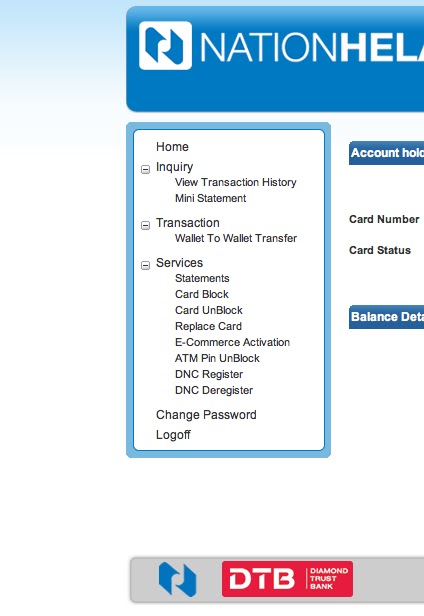
Improving NationHela

Despite the ease of use, and convenience of Nation Hela as an online prepaid card and as a travel card, there are few challenges that need to be tweaked to improve the user experience for National Hela users.

Card Top Up 
The only reliable way of topping up the card is by physically going to a Diamond Trust Bank branch. Agents of the bank don’t handle NationHela top-up’s and surprisingly, Safaricom’s M-Pesa - which would be the ideal way for millions of Kenyans to load a card - does not work all the time. It’s a hit or miss experience, with many phone calls having to be made to Hela at Diamond Trust to trace the date/time/amount of the M-Pesa transfer – only for that to be reversed. 

Account Management
For now you can request for an abbreviated statement by SMS, as well as get an SMS each time you transact with the card in Kenya.  

There's also the NationHela site, where a user should be able to view a history of transactions, and do other functions like block a stolen card. But access to the site remains a challenge - at first it looked like another bank site that only works on Internet Explorer browser and a Microsoft Windows PC combination, but no matter the device tablet, mac, or PC laptop, access to the site is a challenge - with password characters not visible, password changes not reflected, pop-up’s (that are auto-blocked on many browsers due to spam) etc. 

Easy of top-up and viewing transaction history are two essential user experience challenge points that need to be addressed, for the card to get wide acceptance.

Wednesday, May 08, 2013

Cashless Bus Payments from Google & Equity Bank

Someone said that a matatu owner is the seventh or eighth person to get paid at the end of a busy day, only getting residual cash after the driver, turn boy, tout, tax man, council person, policeman, and sometimes the driver's girlfriend have taken their cut. But on Tuesday April 30, Google and Equity Bank unveiled BebaPay, a cashless way for commuters to pay for transport in buses in Kenya - and which propels owners right to the front of that queue.

The transport sector has many challenges and is known for some unpleasant habits like reckless driving, price hikes when it rains, bribing traffic police, ill-treatment of passengers, having unroadworthy vehicles etc. - but some investors who purchase the vehicles than can cost an average of Kshs. 4 million ($47,000) believe that a common thread behind these habits is the amount of liquid money that the sector generates and which is easily diverted to make many payments, even illegal ones. 

BebaPay enables commuters to pay their fares by using a card, which is then tapped to a phone in the bus enabling exact payments (even small ones like Kshs 20 [~$0.25] to be deducted from the user's card and uploaded into the owners accounts that are at Equity Bank.  

Currently, many owners only get to know how much money they have earned at the end of the day, but with BebaPay they are able monitor their cash receipts online or via Equity banks’ mobile phone platform - Eazzy247.

Another feature is that users who purchase & register cards will get SMS notifications each time the cards are used - and this can be a useful for parents who send their kids to from school on public transport to track when and where their kids pay for transport using the card. Also users can send money to people on buses to pay for transport, and the system will also link with M-pesa which is ubiquitous in Kenya.

Obtaining a free BebaPay card takes about 20 minutes at an Equity bank agent - this is to enable them to take down ID and gmail details (even create a new one), and to create a BebaPay account in which a commuter inputs a password. This enables one to get an SMS notification each time the card is topped up and to monitor their card activity online.

Other Comments at the Launch
- The Chairman of the Matatu Owner's Association said he expects some resistance to the changes. He also called on the government to institute training for people who work in the sector and for legislation to eliminate cash payments for transport. 
- One vehicle owner said that gangs run bus stages in dowtown Nairobi and have to get paid daily before a bus is allowed to stop & pick passengers. 
- The Equity Bank CEO said the public transport sector is the bigger consumer of notes & coins and that handling all that cash comes with costs & risks that can be eliminated with BebaPay.

- The Deputy President of Kenya said cash-less payments that go directly into business people's accounts will enable banks to lend based on cash flow, rather that collateral.
- The two permanent secretaries (who currently double as acting ministers) both revealed their past unsuccessful attempts to invest in the matatu business.
- The Nairobi Governor said that  the government will train new traffic marshals to manage traffic at roundabouts which will create employment for the youth and free up policemen for other duties. 
- Every day, 1.5 million Google android phones are activated and 1.5 million Kenyans use matatus. 

Other Reading:

Bloomberg: Major banks in Sweden have stopped handling cash in many of their local branches as many people rely on credit cards, the Internet and mobile phones to make all their payments...bank notes are only used in about 20% of shop transactions. 

The official Google Africa blog notes that BebaPay uses smart cards powered by Near Field Communication (NFC) technology, plus software from Google. The NFC technology means that payment can take place offline, even when there is no power or network connectivity.

Juuchini blog asks Is Kenya ready for public transport debit cards?

Quartz: It is becoming increasingly inaccurate to call Google an internet company  and the free BebaPay app turns any NFC-enabled Android phone into a card reader, which means that shops, traders and small businesses can use BebaPay to accept payments from customers, without needing expensive tills and cash registers. 

Think M-Pesa: Is Google trying to replicate m-pesa? 

Sunday, April 21, 2013

Mobile & Card Payments across East Africa

A new unsecured card solution was launched by afb last week that will allows customers to instantly spread the cost of their purchase at participating shops into affordable 6 month repayments. afb have signed up 52 merchants like Baus Optical, Cambridge Opticians, Fabguru Shoes, Kitengela Glass, and local supermarkets (Tumaini, Home Depot, Homemade) and are also signing up other merchant shops where consumers will be able to apply for cards and get them approved & issued in the stores ahead of making a purchase.  afb settles the transaction amounts directly into the retailers bank account, and the the customer makes repayments via M-Pesa. afb next hope to venture into loans and insurance in Kenya.

How large is the card market? A Central Bank of Kenya reports showed that there were 9 million debit cards and 140, 000 credit cards in use in Kenya in 2012.

In terms of mobile money, CBK data showed that 21 million Kenyans moved Kshs. 141 billion ($1.65 billion) via 53 million mobile money transactions during February 2013.

CBK has also come up with new mobile money rules that target money laundering. They require that operators link different accounts opened by a user with a single ID card, flag accounts that move more than Kshs. 100,000 (~$1,175) per day or 300,000 (~$3,530) per week, have audit trails, institute systems to handle customer complaints and retain transaction data for 7 years. 

KCB and Western Union who have an account-based money transfer service (ABMT) in Kenya will extend it across East Africa this week, enabling KCB customers to receive money from Western Union directly into their accounts.

Kenya Airways has a 1.5% fee on all credit card transactions (owing to high processing bank charges).

Following a spate of fraud incidents last December, the Kenya Bankers Association (KBA) has launched an ATM safety campaign dubbed “Be Alert” or “Kaa Chonjo” which include tips such as cover the PIN with hand, and sharing PIN number with anyone (including spouses) 

KBA also  announced the shift by Kenyan banks to the new Europay, MasterCard and Visa (EMV) technology to ensure better security of cards.

90% of KenyaPower pre-paid electricity tokens are now purchased using #Mpesa - according to an Safaricom Business ad.

Diners can now pay restaurant bills via M-Pesa under a new partnership between Kopo Kopo, Eat Out and Safaricom. Restaurants accept payments at 1.5% per transaction.
 
MasterCard and Equity Bank introduced PayPass enabled debit cards in 5 African markets which will enable merchants to receive payments via low cost add-ons linked to applications on their mobile devices (such as a smart phone or tablet) 

Mastercard and I&M Bank launched a multi-currency (Dollars, Pounds, Euros) prepaid card which enables users to load up  to $10,000 and make foreign currency purchases without incurring exchange rate or other charges.

MasterCard also released a study called the MasterCard African Cities Growth Index that showed that Accra, Lusaka and Luanda offer the highest growth potential in Sub-Saharan Africa. Other ranked cities included Dar es Salaam (4), Addis Ababa (5), Nairobi (6), Kampala (7), Johannesburg  (8), Cape Town (11), Mombasa (12), Lagos (13),  and Khartoum (19).

Credit reference bureaus like CRB Africa and Metropol are expanding across East Africa.

The inaugural Mobile Money Africa Awards will be held in Johannesburg next month, to award the best mobile money app, mobile banking service, and mobile money platform for Africa, among others.  

Nation Hela launched last year has 8,000 active cards in use.

With PesaPal, Kenyans in the Diaspora can send school fees payment directly to 12,000 schools in Kenya using their credit cards (no need for money transfer service). 

Shell Kenya have a visa card promotion to encourage motorists to swipe their cards and pay for fuel The platform is powered by Equity Bank POS at all Shell stations, and station owners are not charged commissions for card sales (Shell pays all commissions).

Tangaza321 is said to be the second largest mover of mobile money behind M-Pesa. The Tangaza system uses biometric data (fingerprints) as many customers don't possess national ID cards and allows them to send money across all networks, even to people who don’t have mobile phones.

A team with the University of Nairobi’s University Students Community Organization (Uniscoo)  has developed a prepaid card for university students. Uniscoo which has 25,000 students seeks to encourage good money management among students through the use of the prepaid card powered by MasterCard.

Saturday, December 29, 2012

Blogging in 2012


Top blog posts in 2012

5. Nation Hela to revolutionize revolutionize debit cards & diaspora remittances.

4. A review of the autobiography of Duncan Ndegwa, first governor of independent Kenya's Central Bank.  

3. Discover who created Safaricom's M-pesa.

2. A re-cap of Kenya's top banks in (year) 2011. 

1. The most read blog post (by a large margin) in 2012 was on Safaricom & CBA's launch of M-Shwari. 

Special thanks to @AngieNicoleOD for helping the blog move to a local domain address this year (after a long period of procrastination)

Monday, December 24, 2012

Credit Scoring the Informal Worker


Documenting the informal economy has been a challenge, the importance of which is increasingly being seen in recent banking, real estate, consumption and other economic statistics that, thanks to data from Telco's about m-pesa and other money transfer systems, shows up as a grey ocean of money flowing (daily) through the economy that amounts to a significant fraction of Kenya's GDP. 

But how about the users who are moving this money? Can they derive credit worthiness value from  this information that is being captured? i.e. These are the self-employed workers, and people without payslips or steady banking habits, but who have some scanty history with banks, savings societies, church groups, or utility companies. 

But now with services such as SelfCare from Safaricom, one can see three months of M-Pesa transactions – and in the last three months, funding a project outside Nairobi, I’ve deposited about $3400, sent about  $2800, withdrawn $200, received $150, and bought $100 of airtime.

All that should qualify for more than a Khs 2,000 ($25) instant loan from Safaricom/CBA's, M-Shwari, but since it's a new system, it may be too early to determine the credit worthiness of a borrower, using their  M-Pesa history alone. Selfcare could, with time, become more useful, allowing users to export or print statements,  older than three months, and other financial institutions to access & review the data  - and with that, a hawker, taxi driver, or other self-employed worker, without a formal banking history could generate a decent, mature,  credit position to discuss with a new bank. 

Wednesday, November 28, 2012

Safaricom & CBA Launch MShwari

This week saw the launch of what is likely to be a revolutionary mobile phone product  called  M-Shwari. It comes from two long term partners - Kenyan mobile company Safaricom, well known for it’s world famous  mobile money product - MPesa, and a local bank, the Commercial Bank of Africa (CBA) who have been custodians of M-Pesa funds for years
MShwari is a savings and loan product that is immediately accessible to the 15 million users of Safaricom’s  MPesa. It gives them access to banking services – savings and loans without having to walk into a bank hall or fill out a single form. It allows them to save as little as 1 shilling (earning interest of between 2-5% a year) or borrow as little as 100 shillings (Kshs 100 is equivalent to about $1.17) and attracts no account maintenance fees or transfer fees.  It will be a great product for people who run informal businesses and take money home at night in pockets or blouses, or envelopes to stuff into mattresses, as they now have a simple tool which they can use to instantly and simply save by clicking into their phone SIM menu. 

In it’s current evolution, with a maximum loan limit of Kshs 20,000 (~$235) this is not a banking product  that will threaten the banking fraternity – for now.  What it will impact are the savings and credit societies (SACCO’s) and shylocks who people turn to for payday (month-end in Kenya) and emergency loans. With MShwari, they can  apply for loans on their phones, repay by phone, get statement by phone and won’t have to get 2 or 3 guarantors (SACCO) or exchange an electronic item or vital document like a logbook (Shylock) to get it. But like with SACCO emergency loans, the terms are strict and not cheap. You can only take one MShwari loan at a time, and one has to be paid before another one can be taken up. 

In the five years since M-Pesa was introduced in Kenya, banks have gone from fighting mobile phones intruding on their financial turf to fully embracing the convenience. About a dozen banks, now integrate their bank platforms with M-Pesa, a partnership between Equity bank and Safaricom got over 700,000 accounts in it's first year, and two months ago,  Nation Hela was launched by the Nation Media Group and Diamond Trust Bank to bridge remittances in the Diaspora to debit cards and mobile phones.

But, when (then) Safaricom CEO, Michael Joseph spoke at a  Fireside Chat at the iHub in 2010, he had a warning to banks, saying that retail banking will disappear in 10 years time. Customers will not go there (to brick & mortar branches) except for loans, as ordinary banking will be on mobile phone whose convenience is unprecedented. 

Other MShwari Notes
- The 7.5% charge per loan looks simple but can be astronomical for a repeat  MShwari borrower. However, such a person is probably already serial borrower elsewhere without  accumulating any savings.   
- In terms of default protection, the loans is self securing in that for each loan, an equivalent amount of a person savings in the phone are  frozen until the loan is repaid. Also, with five years of M-Pesa data, its unlikely that people will default on an easy product. The MShwari brochure states that borrowing will be based on this savings and past usage 
- The MShwari T&C go quite a way to exclude CBA from dealing with the customers who’s savings and loans they are handling by stating that no MShwari services will be performed at any CBA branches
-        - A side story to this is the amazing ability of the two institutions and the several government regulators to keep a secret going for several years.

Monday, October 29, 2012

Who Created M-Pesa?

M-Pesa is officially over five years old and is celebrated as the greatest use of mobile money in the world with about 15 million users. But the question of who created M-Pesa has never been resolved..until now. 

On Sunday, there was a day long outage of M-Pesa which Safaricom attributed to  a power outage on a Vodafone server in Germany and this started quite a bit of discussion on twitter about why the service is run from Germany and how authentically Kenyan M-Pesa really is. 

I’ve been in touch with Paul Makin before and so I invited him to join the conversation by tagging him and he went on to engage by giving answers to questions from twitter pals like @MediaMK @IddSalim @TerryAnneChebet and @Coldtusker who were genuinely interested and drove the conversation. 

Excerpts: 
- No-one GIVES me authority. As the original architect, I TAKE it.
- Original team was Nick Hughes and me. I came up with concept and architecture.
- Nick forced it through the business. Susie Lonie joined after about 6 months.
- This was all back in 2004. Took 3 years to get to launch.
- Susie made sure it worked on the ground. She went round forcing people to work together.
- We chose Sagentia to do the build. They did a good job. M-Pesa was a good team in those days.. didn't say that. The TEAM chose Sagentia.
- So I didn't build it, the team did. It was my concept and original design, though.
- DFID money said KE and/or TZ. We couldn't find right partners in TZ.. plus we liked entrepreneurial culture in KE. People were keen to work with us.
- It was matched funding. DFID money only helped pilot. VF money funded the live service. VF invested a lot.
- VF own all the IP. They paid for it.
- There was a small pilot. Once proven, VF turned it into a commercial service
- SF extremely helpful, and KE a good environment for innovation. People willing to try new things and try to make business!
- No but they were a good partner network. Very supportive. And you can't do proper security without being in the network!
- We spent a lot of time in KE, talking to ordinary people (not big business). That's where the idea came from
- I get annoyed when I see people who joined months/years l8r claiming they designed it!
- we talked as a team in a Nairobi bar. Came up with it, asked the barman (edit). He liked it, so it stuck. VF didn't like the name. Not corporate enough. But Nick fought for it, and won.
- Wouldn't have happened without him. He made sure SF worked with us, and worked with Nick to get it through VF
- There were the agents, who worked very hard. Without agents, M-Pesa is nothing.
- Lots of people came out of the woodwork, trying to claim it. Not good.

What’s Else is Known?

The 2008 Safaricom IPO prospectus noted that; 
All intellectual property rights in M-PESA belongs to Vodafone and are licensed to Safaricom under a trademark licence agreement…Vodafone shall provide the managed services to Safaricom and shall authorize Safaricom to operate the M-PESA service in Kenya. Safaricom shall market and offer the M-PESA service to prospective customers, agents and merchants in Kenya and will be responsible for all associated end user facing activities …

When (then CEO) Michael Joseph spoke at the iHub in 2010 he said this about M-Pesa;
...Vodafone won £1 million DFID (UK) award for deepen financial penetration for the unbanked, which they also had to match financially – and they were to develop a system for the disbursement and repayment of micro finance loans. They tested in Thika for 6 months and realized that it had more potential as a money transfer tool, and they launched M-pesa in March 2007… also that big multinational banks who had shut down rural branches abandoning their customer opposed m-pesa and fought in government & parliament and would have succeeded till he persuaded acting finance minister John Michuki to green light M-pesa.

Other attributes on the origin and prevalence of M-Pesa in Kenya include:
- Different groups of Kenyans who say they invented M-Pesa.
 -There's a lawsuit hanging over M-Pesa
- The  agent network or the branding as the reason for its success.

Friday, August 17, 2012

Nation Hela to revolutionize remittances & debit cards in Kenya?

On August 15, 2012, Kenya’s Nation Media Group (NMG) launched NationHela in partnership with Diamond Trust Bank and Craft Silicon. NationHela had been first unveiled the previous week, when NMG announced 14% revenue growth to Kshs 5.8 billion and a 23% rise in profits of Kshs 1.37 billion and an interim dividend of Kshs 2.50 per share  for the first half of 2012.

Why NationHela? For NMG that has millions of online newspaper readers every month, a good fraction of who are in the diaspora, and who also send remittances to Kenya, the platform is a chance for them to send money without leaving their computer (or logging off the newspaper site)  – by entering debit or credit card numbers to send to a Kenyan phone number. 

At the launch, a Central Bank of Kenya a figure was cited of remittances of $590 million in the year  to June (up from $409 million the previous year) through formal money transfer channels.

Senders also get value as NationHela can be 30% cheaper overall (charging $12.5 to send $200 compared to $15 for other services), while for  the recipient it knocks out the necessity of taking a matatu (vehicle) to town or finding a Western Union agent to withdraw cash. 

 Diamond Trust who are the 7th largest bank, and the largest agents of Western Union in Kenya, handled the banking regulatory and approvals, and will also do the back office processing of money movement, agents, currency exchanges, float etc., while Craft Silicon provided the mobile interface (familiar to anyone who’s used their Elma) through which users will access Hela by USSD on a mobile phone to get notifications, send or receive money through mpesa to other card users, pay some utility bills, block a lost/stolen card, see a mini statement /balance among other features.

Some cited uses of the card include:
- Make online purchase as a visa debit card
- Move money to or from mpesa
- Withdraw cash at any ATM via visa
-  Use the debit card in a supermarket to make payments

Other future or potential uses include:
-    Pay dividends straight on to cards (maybe starting with Diamond Trust and NMG shareholder)  
-     Kenyans with paypal can move their online money on to the card and cash out payments
- Senders will also be able to too how card recipients use the money they have sent (perhaps answering along standing issue about misuse of remittances 
-  Take NationHela to Tanzania and Uganda where both the Nation and Diamond Trust are
-   Pay staff travel  allowances and imprest at companies (said to happen at NMG)
 
Outlook Some concerns have been expressed, that NationHela may not work out, or that it's going to distract NMG  from it's core media business. Also the web interface needs some tweaks to make the card easier to work.

While the awareness and usage of debit and credit cards in Kenya has been low, for NationaHela there  are plans for online education & marketing campaigns targeted at the diaspora, combined with road shows and town hall meetings around Kenya to register users, convert agents, and show how to use it on a day to day basis - and we’ll see where they are in a year. 

LinkWithin

Related Posts with Thumbnails